
The cremation of a person descending from the royal family of Ubud is a rare sight to behold, since such occasions where ceremonies are held because of an extremely important person’s passing was not an everyday’s business. Therefore, we had the great luck to witness such an important event, which was public to all the tourists and locals, who flocked in a great crowd to spectate this wondrous event.
It was Sunday when we took a mile-long pilgrimage towards the Royal Palace, where the grand ceremony would be taking place. The steaming sun gleamed brightly over the back of our necks, casting thick shadows upon the iridescent road. At this stage, although mostly locals, there was a considerable amount of tourist. They could all be seen, travelling the same direction towards the palace. They all chattered incessantly amongst each other, exhilarated by this unique occasion which they had the great fortune to experience.
After a short while of walking, we arrived at the Royal Palace, where all preparations had been made for the ceremony. Crowds had already been formed, although it was not nearly time for the great ritual to begin. A tall golden structure could be seen, gilded with rich, colourful ornaments that glistened in the brilliant light. (We had encountered this great spectacle many weeks ago, when it was still under construction, and knew that the majority of the material which formed this structure was rough wood and long bamboo poles assembled by dozens of men.) Colossal masks, depicting demonic faces, poked out in between the decorations. Their uncanny, menacing faces displayed humanoid body parts which were distorted, such as their eyes, which protruded out their faces, emitting a powerful gaze towards the crowd. The tower was extremely lofty, and loomed more than a hundred feet high into the sky. On the base of this structure were bamboo poles tied into a grid-like shape by what seemed to look like rough bandages. Hundreds of men sat below on the ground, making preparations to carry the tall structure.

Another great structure could be seen nearby, depicting a indigo-coloured cow (lembu), which was to be incinerated alongside the coffin. It, too, had a terrifying gaze, unsettling the viewers, for this was symbolic for its potential strength and power. Embroidered on its neck were numerous accessories, including necklaces which were worn on top of a golden plate, protecting its chest. All its limbs had an intense, golden colour: its abdomen, back and even horns had this feature. Its face wore an indescribable expression, that of anger, distortion and unease.

Before the ceremony had started, we made sure to wear the appropriate local outfit (A sarong, a belt and Udeng) to respect the local tradition. By this time, we could see colossal gongs and drums, which were being carried to their appointed places. Not long after this, we saw the wife and daughter of the king’s brother, being carried on their luxurious sedan chair, towards the interior of the palace, a place which was private to the Royal Family.
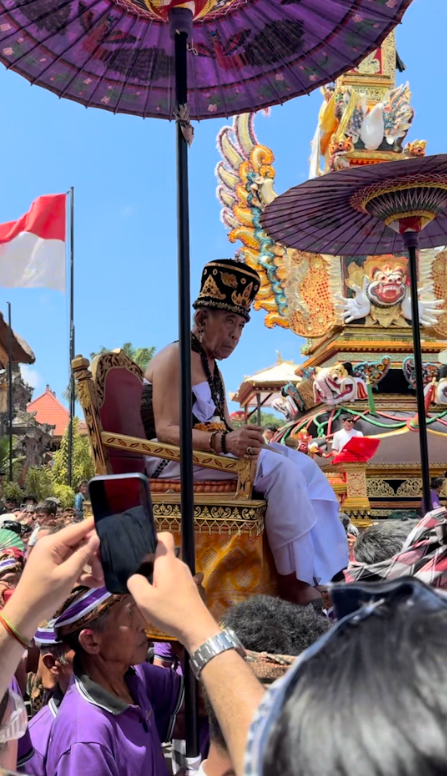
As I descended from a local cafe into the maddening frenzy of ecstatic people, drones could be seen whizzing about in the air above our heads. They seemed to be more common than the flies which taunted our bodies. By this time the locals began to play numerous instruments, including the enormous drums, gamalans and others. The music sent a rippling reverberation through the air, creating a cacophony which shook the very core of our beings. It numbed the loud chatter of distant peoples, and seized everyone’s attention instantly. Already it seemed so grand compared to other ceremonies, and made every individual seem insignificant compared to its euphoric symphony. Even though this was just the opening to the King’s brother’s cremation, it was already a lot for the mere human mind to take in.
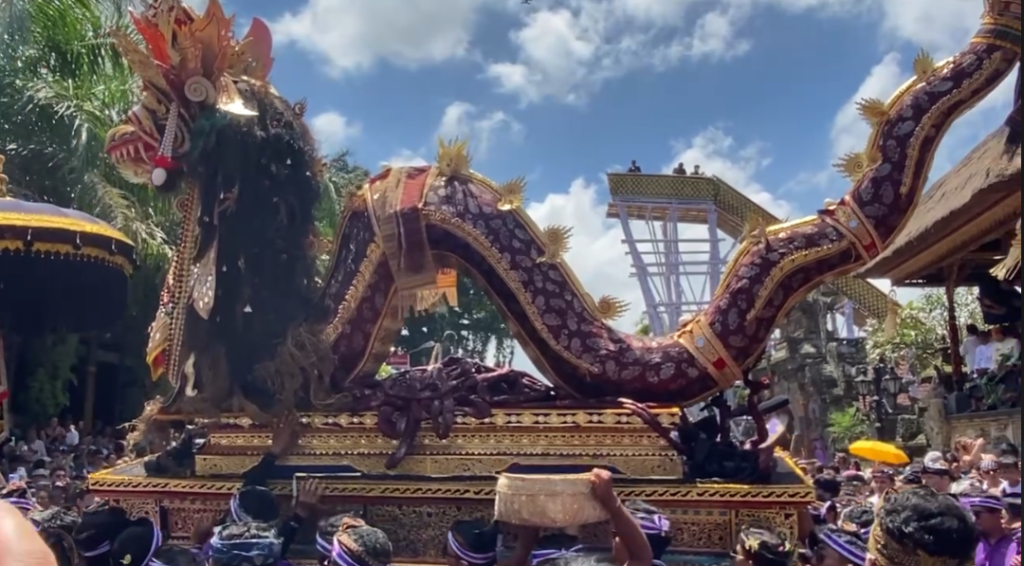
After the music had died down, we could see a sculpture of a sacrificial snake being carried down the broad street. The structure stretched over 30 feet lengthwise, and I was captured by its unique structural form, which differed from the two lembus which I had seen beforehand. It had great symbolism which was engraved beneath its sculpt. Because the snake looked like a thick lace of rope, it symbolised the knot which tied/kept people to their worldly possessions and close ties towards the community, which the king’s brother was certain to have a lot of. The detail which it displayed was perplexing, as it wore countless different decorations; a structural integrity too complex for the mere human vision. Every segment of its body was terrifyingly uncanny; its mouth was gaping, showing off it’s colossal protruding fangs, and its eyes unsettled everyone through its mesmerising gaze. Although it was the smallest sculpt out of the other two, it emenated a divine aura which struck great wonder and amazement; every ornament which it bore homogenised into a pristine sculpt. Accompanied by the other rituals and grand openings which was happening, an overall tantalised captivation overtook me. Metal gongs and drums sounded through the steaming air, locals danced in excitement through the glittering midday sun, pristine sculpts were being heaved hither and thither; it was all a shifting amalgamation which expressed a euphoric harmony.

The time which the ritual would begin neared, as everyone darted their gaze upon the numerous things which were going on. The air was stiff and humid, contaminated by the continuous trickles of sweat which rhythmically dripped from our faces. Although I felt claustrophobic and sick from the atmosphere, this annoyance was dulled out by the outstanding, magical rituals and gamelan playing which was so unique. We promptly saw the king’s brother’s body being carried up a steep, narrow bridge which planted itself from the royal palace grounds to the lofty cremation tower. As soon as the sarcophagus was visible, we all strived to encapsulate the rough outline of this grand box with our cameras. Our eyes fixed a piercing gaze to this tiny sarcophagus which was slowly being carried by two men, transfixed by the arduous work of carrying the sarcophagus. These two men, along with the sarcophagus, entered the tip of the tower, which was nauseously high in the sky. This was the marking point which indicated that very soon, the ritual would begin.
The sun continued to gnaw upon our profusely sweating flesh as we watched the spectacle spring into action. By this time it was already past midday, and it was finally time to begin the ritual. An unquantifiable amount of trusted locals were to carry the enormously tall cremation structure, which contained the king’s brother’s sarcophagus, a dazzling few kilometres to the cremation ground, where they would burn everything: the sacrificial sculpts and the sarcophagus. We all watched in awe and trepidation as a few seconds stood between this unforgettable experience. Everyone controlled their ecstatic hyperventilation as the countdown began. We all chanted the last numerical numbers which chronologically descended into zero, and in a flash, the action begun.
With a great heave, the tower was lifted up into the air. It maintained stability, by some miracle, as the men which carried this tower began to run towards us like crazed children. A guard promptly ordered us to make way for the gigantic tower, as we were blocking its path, and like some sort of domino run, everyone stumbled upon each other, a hilarious sight as we all fell away to the side of the road. After a twenty metre sprint performed by their burst of energy, the men rested the tower upon the ground again. By this time, the tower had already surpassed most of us, as we formed a thick line of rope made of people, lay strewn by the side of the street. In short intervals, they continued to heave and halt, as the tower, by some divine intervention, rapidly paced towards its destination.

Almost all of us were now lagging behind. It took great effort to make minute progress, as there was a vast mob of people who had the same intentions. There was a miniscule amount of space between me and the surrounding people, and getting past them took precise squeezing through, which could be done with what my brother called “my two-dimensional body”. The maddening rat race continued, as I weaved through the endless stream of people who paced towards the promised cremation ground. Since I had already lost my brother and father from the dense crowd, I paced forward freely on my own, like a tramp let out loose.
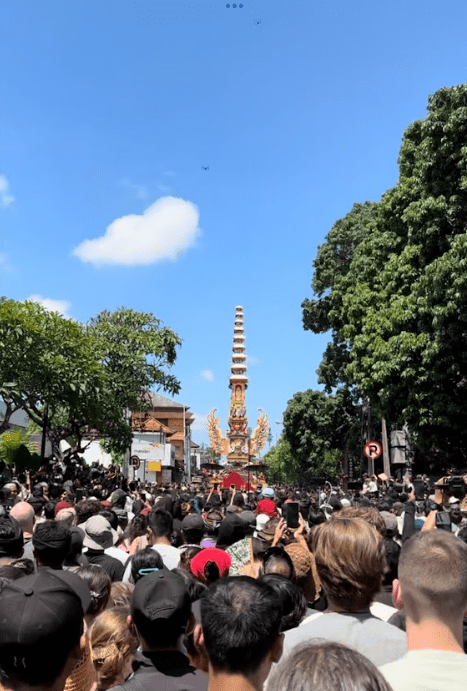
This continued for many minutes, even hours, as our semantic souls strived for the sight of this serendipitous scenery. Although this walk should have only taken a few dozen minutes, the impregnable crowd slowed it down to many tedious hours. The sun was baking our skin through its impenetrable heat, and slowly cooked us into a perfect medium-rare. My throat was dry from the effort of having to stand up in the unrelenting, blazing sun, and a deep soreness clung onto my legs. I received a text message from my brother, William, who wished me to meet up with him at a random store. After trying to locate this store which he had photographed to me, I concluded that I had to backtrack to meet him. My only motive to meet my infinitely annoying extrovert brother was that I thought something major had happened, although this was shortly after proven wrong, as after meeting up in this place, he told me that he had just “wanted to see his cool bro”. I had now accepted my fate, as I knew that I had trapped myself into the periphery of my older brother, who would trail behind me like a damned leech. I could not escape his grasp, as he refused to be separated from me. He remarked on how he felt like a “sardine in an oven”, as he also felt himself cooked by this claustrophobic nightmare. We shortly after stopped at a nearby restaurant to replenish our thirst. As I knocked back a whole bottle of water, I felt enlightened by the refreshment it gave me, and soon after joined back with the crowd. Although his company was very humorous, it was still nonetheless annoying. Like wandering spirits, we continued to pilgrimage towards the cremation ground, oblivious to the spectacle we would encounter there.
After an eternal samsaric cycle of walking and sweating, we finally saw the junction which turned to the cremation ground, our destination. The crowd had slowed down significantly, as individuals slowly shifted to a nestling place where they could see the rituals taking place. Eventually we were almost halted; slow progress had been made since we reached the junction. The surrounding scenery of the cremation place filled my peripheral vision. Surrounding the cremation ground was a light pack of trees which shaded steep stairs, made of marble, where people sat upon. Towards the middle of this place, the sun boiled the smooth cement which paved its way through this area. Although it seemed relatively small, there were already hundreds of locals and tourists in this place, ranging greatly in age from toddlers to old sages. Planted outside was the cremation tower, which tilted in a concerning degree. My father had personally seen the cremation tower being landed on its appointed place. Like a Greek myth, he told us how the tower had swayed hither and thither unstably as it had been landed, and several men, who were at the tower’s summit, “clung onto their dear lives” as it immaculately maintained stability and did not fall.
I continued to observe the scenery as we entered the cremation ground. The music had begun to play, multiple gamalans and other instruments sounded in unison, their tones hissing and booming through the air. Unlike the previous music that I had heard in the Royal Palace, this one was much more magical, more perplexing, as the dissonant screeching of instruments coagulated into a mellifluous harmony. Multiple ceremonial objects were being shifted about so that other important rituals could be performed. Out of all of them, the most significant were the sacrifices, which with their great weight, proved to be an arduous task for the men to place them upon the cremation ground. This ground was elevated by about 20 feet, and was an area of 200 square feet. Gradual stairs led to this square pavement, which the men who were carrying the structures, alongside the sarcophagus of the king’s brother, used for their convenience.
After a short ten-minute interval, which allowed all the previous events to sink deep into the soul, it was time for the king’s brother’s family to witness the sarcophagus, which required ascending the steep flight of stairs which led to the cremation tower. A few appointed locals, with great courtesy, carefully helped the mother and sister of the king’s brother up the flight of stairs. They ascended slowly; the two who were helping them made sure everything would be seamless. We all watched in silent, solemn regard, although the music was still resonating the air with great loudness. After disappearing into the tower for a few minutes, the family reappeared, descending yet more slowly down the steep decline. Here, at this angle, I could see them clearly. They were dressed in full black, and wore sunglasses to conceal their mourning. For a brief moment, the wife and daughter took off their sunglasses, and I saw the deep bloodshot red which marinated through their eyes. Although I believed that their sadness would not cease, as they were about to take a photo, their demeanour suddenly changed into a smiling, joyful vibe. It strikes me how quickly they can recover from a deep state of sadness to a state of dignity and charisma, as if this extreme mental power was just an everyday affair. My father, in his account after the cremation, was struck with wonder by this true, genuine quality. To his disappointment, he refused.
The sarcophagus was then carried down a flight of stairs, concerningly steep, from the tip of the cremation tower to this cremation ground. Followed by this, was the indigo-coloured lembu, the nagabanda snake and an additional lembu, drenched with a deep dark colour. I felt great anxiety as the carriers struggled to rest the structures upon the ground, which swayed unsteadily.

After all the rituals had been prepared, a series of ceremonies began. Firstly, the king’s brother’s sarcophagus was brought down from the cremation tower, carried by a few men, and they circled the cremation ground in a slow, ritualistic manner. Their movements seemed as if they were performing a trance, as they were intensively enthused into the importance of this ceremony, and how they played a major role in it. I myself was captivated by the whole spectacle, as it was deeply spiritual and ritualistic, much more than what I was used to in Bali. In no more than a few minutes, they had finished circling the ground approximately 9 times, and delicately placed the sarcophagus in the centre of the cremation ground.
Following this, after the two lembus and nagabanda had been precariously placed beside the king’s brother’s sarcophagus on the cremation ground, was an important dance called the Baris Biasa dance. Although I was both famished and fatigued from the incessant overload of outside activities, I was still enthralled and fascinated by what would be performed next. The Baris Barisa dance that was performed was one of the many other Baris dances that coexisted; most were performed solo with a certain weapon, although others were performed by multiple dancers. In this case, it was composed mainly of a multitude of dancers, who wore leaf clothing around their waist and body, and danced with wooden spears. Oftentimes they would purposely collide, as this symbolised the bravery and boldness of a young warrior. The artistry and punctual movement that was displayed was awe-inspiring to me.

The time in which the ceremonial burning upon the cremation ground would neared. Only a few more procedures had to be done before it was finally time. Up to this point, we were bombarded with experiences, all unforgettable in their own way. We stood and waited in unbearable trepidation, as we saw a fire truck, arriving with a water hose. Gasoline was slowly poured around the sarcophagus, to ensure that the flame would be a healthy one. After all preparations had been made, a match was lighted, and then dropped amidst the beautiful sculpts. Steadily, the flame grew, and flamethrowers were used to create additional fire, speeding up the process. Now, it was a great, blazing inferno, a fiery hell which danced according to the soft ushers of wind. It cackled lunatically, as it gnawed through the flesh of the structures, and emanated a boiling heat, which seeped through the pores of my skin. I was close to the fire, as I wanted to see the performance in a better peripheral view. A pungent dark smoke, in great lines of wisp, weaved through the air, creating a mirage which spasmodically quivered through the humid air. The fire was a deep orange colour, an iridescent glow which resonated through the burning rage of wrath that consumed the structures. Chunks of dark depression fell from the once pristine wooden effigies, burned to a pitch black crisp. Not so long after, a great chunk of the nagabanda also fell, spilling its contents on the ground, scattering its burning remains in a great circumference. These remains turned into embers, which glowed with the faint fires trapped within it. I found great significance from this burning; perhaps a final ferocious flare of life before being exhausted, extinguished and devoid of fuel. In no longer than five minutes, the only thing that remained standing amidst the cremation ground was the backbones of the structures. All the other chunks of wood which were once combined into a beautiful structure, rotting from the miniscule sparks of fire which leeched off its material, striving to preserve its flame. And all that was left after the great burning, were powdered ashes, resembling nothing of what it once was.

The cremation had ended. People started to exit the gates, all changed from this one in a lifetime experience. I stood there, observing the remains of the structures, and felt as if I went through a bildungsroman in six hours. We met up with our painter friend, named Krishna, and left the place, to relax ourselves in a Chinese restaurant. He had made a few paintings depicting the wonderful scenery of the cremation, and although we were exhausted, still took great interest in his unique paintings.


 Rich&Will's Exp Travel
Leave a reply to oppenheimerfredagmailcom Cancel reply