
The scenery gradually transformed as our car ascended steadily towards the majestic Besakih Temple, nestled on the slopes of Mount Agung (an active volcano in Bali). The thinning air carried a crisp and fresh scent which grew more prominent every metre we climbed, a hospitable change from the usual warmth. A few small shops by the side of the road ineffectively tried to cover our view from seeing the large expansive fields behind them, it was almost as if these houses served as civilisational cracks that ran through the Balinese wilderness. Only Mount Agung stood there uncontested, no measly attempt could possibly try to cover up the grand looming mountain, its presence stark and awe inspiring – a sight utterly alien to anything back home in Penang.

After a tedious parking session, we could finally fully appreciate the expansive, bright and dramatic landscape. Our field of view, enveloped in almost a heavenly whiteness which in many circumstances could very well supplement a trance state. Adhering to local customs, we clothed ourselves with the traditional Balinese sarongs and udengs—essential attire for entering any sacred spaces here, reflecting the deep cultural integrity maintained despite the heavy flow of tourism, an integrity I deeply admired. This is further shown upon the locals’ relationship towards the tourists: even though they are definitely not inhospitable, there is clearly a strong boundary of complete acceptance towards their own tribe or family.
After meeting with our tour guide, an electric cart carried us up a steep incline to the temple’s base. As we slowly ascended once again, it was evident that the temple was a hub of activity, bustling with locals in their traditional white attire, sarongs, and the ceremonial rice pressed to their foreheads. Wearing the sarong and udeng for the first time felt slightly awkward, marking us clearly as novices amidst the sea of pristine white, but it was also thrilling to momentarily immerse ourselves in the local culture—even if our more vibrant attire gave us away as tourists instantly.
We arrived at Besakih Temple during a pivotal moment—the annual festival when, guided by astrological timings, devotees from across Bali converge at the mother temple. The sheer number of locals was overwhelming, a testament to the importance of this sacred occasion. We were incredibly fortunate to witness this cultural zenith, because the timing allowed us a rare glimpse into rituals performed exclusively for locals.
Among the most captivating experiences were the sacred dances. These weren’t staged for tourist cameras; they were authentic rituals, steeped in spiritual significance. The dancers, adorned with intricate masks, seemed to channel divine energies, transporting both performers and audience into a trance-like state. Beside them, rows of devoted worshippers sat in prayer, the pristine white simplicity of their garb seemingly aglow against the dark intricacies of the architecture. This contrast also includes the brilliantly bright sky, which seemed to emanate light but not heat; the whiteness of the clothes almost served as a transition from the heavens into the dark architecture – this is ironic (and perhaps intentional) as this temple and ceremony acts as a bridge from heaven and earth, where people’s gifts are accepted to their desired gods.
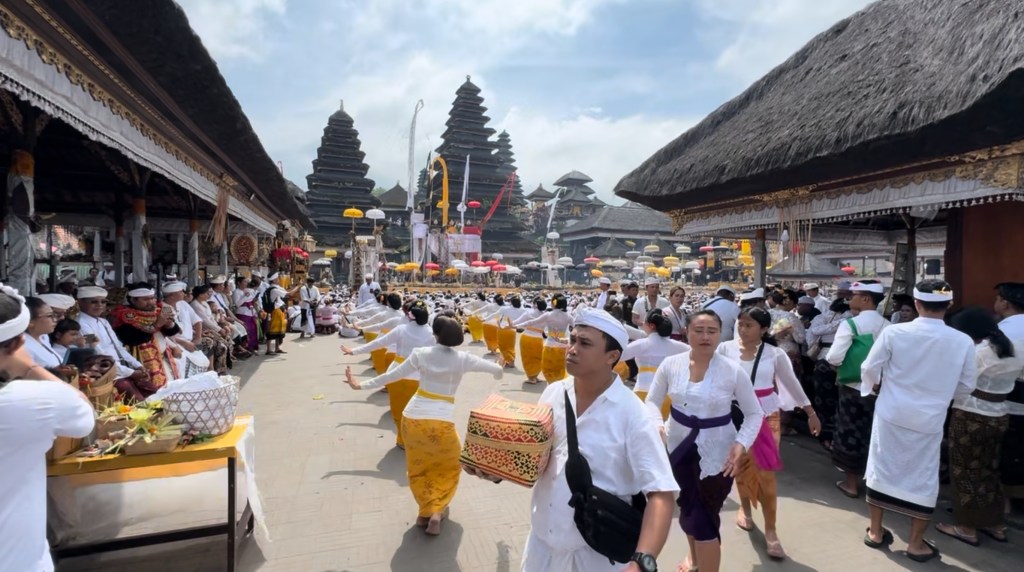
Our guide, understanding our keen interest, skillfully navigated us to vantage points where we could observe these dances. It felt like peering through a window to the soul of Bali. Once, in his eagerness to get a closer view, my dad, encouraging me to accompany him, ventured a bit too near the prayer area. Thankfully I had held back, as to my shock he was promptly manhandled out of there.
The temple complex itself was divided into three distinct sections, each dedicated to one of the Hindu trinity: Brahma the Creator, Vishnu the Preserver, and Shiva the Destroyer. The temples varied in colours and decorations which reflected the unique attributes of each deity. Additionally, there were smaller familial temples scattered across the grounds, sacred spaces reserved for descendants of specific families—areas where we, as outsiders, were strictly prohibited from entering.
As we continued our ascent, we discovered that the number of temples more sparsely distributed the higher we climbed. It was as if the temples were intentionally positioned to create a spiritual journey, with each step leading us closer to a more profound sense of devotion and sanctity. We learned that there was a row of temples almost hidden in a line further up the mountain, each one smaller yet imbued with a deeper sense of holiness.
At the highest peak we reached, we encountered a temple dedicated to one of the highest gods. Here, the atmosphere felt particularly sacred, as if we had stepped into a realm closer to the divine. The air was cooler, and the silence around us was profound, broken only by the distant sounds of nature. As we stood there, taking in the breathtaking view and the serene surroundings, we noticed a subtle shift in the weather. The clouds, which had been white and fluffy, began to darken, and the sky took on a brooding hue.
The change in atmosphere was so gradual that it felt almost imperceptible, making the impending rain seem sudden and dramatic. The once bright and welcoming sky turned ominous, casting a shadow over the temple and adding a sense of mystique to the already powerful spiritual energy of the place. The approaching rain added to the sense of awe, as if nature itself was participating in the reverence of this holy site.
As we began our journey back down from the temple, the urgency of the impending rain became palpable. The once serene atmosphere was now charged with the frenetic energy of people bustling around the temple grounds, trying to find shelter. The pathways were crowded, and there was hardly any space to move. Devotees and tourists alike pressed together, creating a chaotic scene as everyone sought to avoid the approaching downpour.
The first few drops of rain fell, and then the skies opened up, releasing a torrent of water. We hurried to the nearest shelter area, but to our dismay, we learned that we couldn’t use the same electric cart that had brought us up. The rain intensified, and the temple’s steps became slick and treacherous.
As an energetic teenager, I saw this as a challenge. I decided to take matters into my own hands and sprinted down the side of the hill. The rain poured down in sheets, but I felt exhilarated, my senses heightened by the thrill and the freshness of the rain. Each step was cushioned by the power of my Achilles tendon and the natural arch of my foot, propelling me forward with a spring-like energy.
The steep incline, which had seemed daunting on the way up, now became a thrilling downhill race. The terrain was uneven, but my youthful agility and the cushioning of each step allowed me to navigate it with ease. My clothes were soaked, and the rain stung my face, but I felt a surge of freedom and vitality.
The vibrant greens of foliage and greys of buildings whipped past me, a verdant blur against the darkened sky. The thunderous roar of the rain was punctuated by the rhythmic sound of my footfalls, a steady beat in the chaos. My heart raced, not just from the exertion but from the sheer exhilaration of the descent. Each step was a dance with gravity, a delicate balance between speed and control.
As I navigated the steep decline, my thoughts began to wander, mingling with the rain-soaked air. The urgency of our descent, the bustling crowds, and the spiritual energy of Besakih Temple all melded into a single, vivid experience. The journey down the hill became a metaphor for the profound connection between the physical and the spiritual, the earthly and the divine. In that moment, every droplet of rain, every step, every heartbeat felt like a part of something larger, something ineffable.
The hill stretched out before me, a seemingly endless path leading down into the mist. My sprint felt like a flight, each stride carrying me deeper into a state of flow, where time and space seemed to dissolve. The world was a symphony of sensations— the cool sting of rain, the solid ground beneath me, the rush of wind against my face. I was fully present, immersed in the raw, unfiltered beauty of the moment.
And so, with the rain pouring down and the hill stretching endlessly before me, my journey seemed to have no end, a descent into the heart of nature and self. The path was uncertain, the destination unknown, but in that relentless pursuit, there was a sense of profound discovery, a feeling that each step brought me closer to an unseen truth.
 Rich&Will's Exp Travel
Leave a comment