
Chauvet Cave – Richard, France
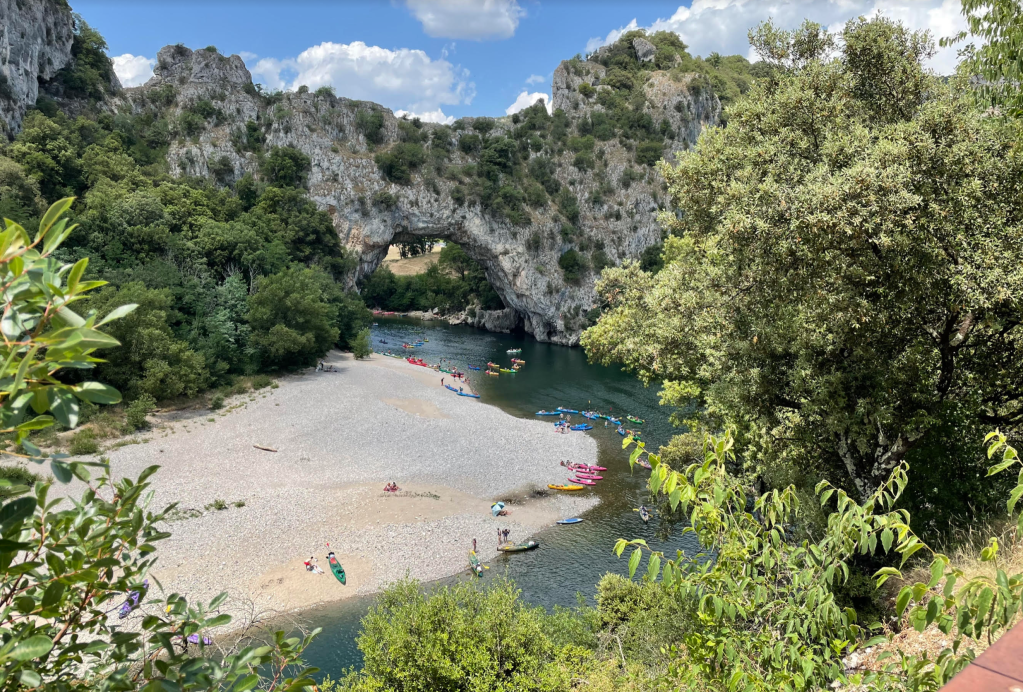
We started our first day in the Ardeche filled with zing, since the campsite that we nestled in was surrounded by Pont D’arc, where people cramp up to the beach side, doing a variety of different things. For instance, the demanding sport of kayaking, perhaps people racing hither and thither and young children splashing and paddling around the shallow water. Perhaps some would even challenge themselves to climb up The Arc from the water itself! Not far beyond the narrow road was the renowned replica of Chauvet Cave, explaining dozens of millennia of history, holding the very record of the oldest paintings known to the modern world.
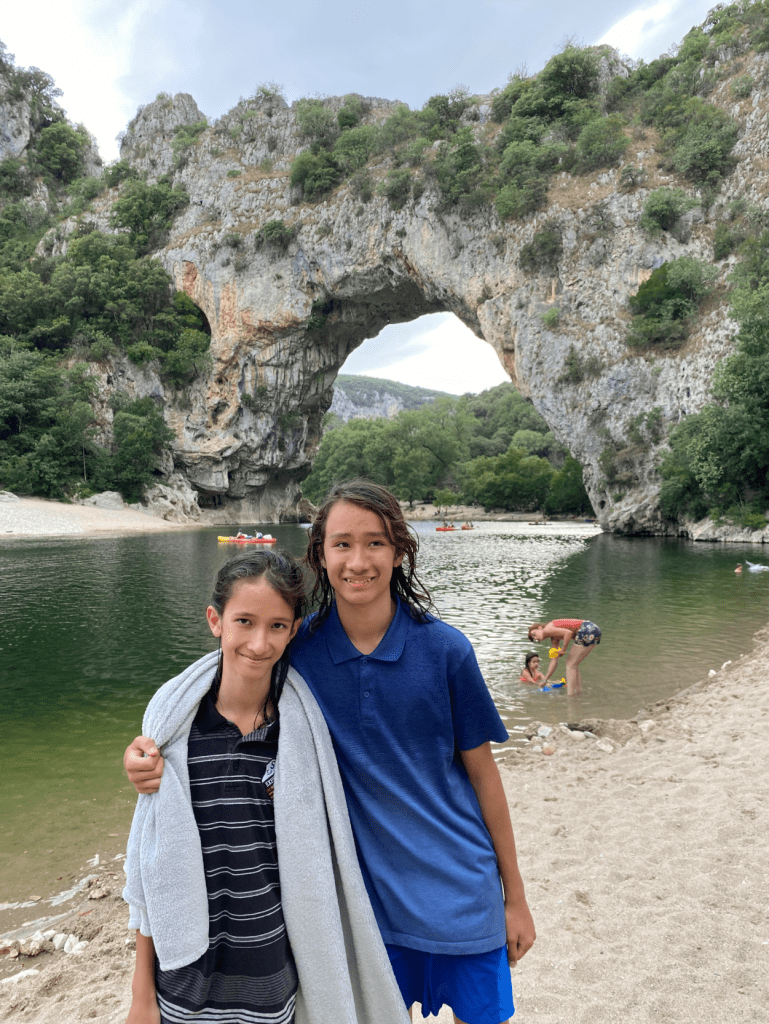
We decided to explore both Pont D’arc and Chauvet cave. After debating with each other on which order we should do both of them, we decided to visit Chauvet first. So when the sun beamed down its hottest, signalling that it was mid-day, we drove our van down the sketchy roads into the parking lot.
The architecture of the gift shop building, where you could also book your tickets, was modernised, meaning a plain and bland building with no colour or ornament. Swiftly we booked a ticket, scuttled through the empty ghost-like restaurant into a road that split off to different buildings of which operated in different manners.
Staring at the map, we were deciding which place would be best to visit first. Within a few minutes of changing our ideas for the first place to visit, the Mammoth and the Rhinoceros room caught our eyes, because this was where they projected an animation of all the animals that existed at that place at that time. I found this really interesting, I shall be talking about this for a few paragraphs…
As soon as we entered the darkened room, we saw a plethora of paintings designed by artists at different times. For example, an incredibly detailed painting of a Hippopotamus by Albrecht Durer. All of a sudden the animation started, deforming the colours of the paintings into rainbows. Vines started growing around the animal’s body and grass as the ground, and eventually new animals started to sprint into the screen. They then dimmed the movie, shifting into different captures of nature with different animals which existed a few millennia ago. The sound was synchronised with the movie, making the animals more vibrant. The scenery and sound were peaceful, occasionally some animals snorting or some leaves rustling. It even showed what was happening underground! The earthworms crunching softly through the soil, the rats and beavers feeding their babies in subterranean nests!
The movie waited for us to fully be familiar with the environment, then slowly shifted down to a cave underground, presumably Chauvet cave (although it could be any other one). There was water dripping down from the rocky roof, echoing in our ears. Out of nowhere came fireflies, the only light in the darkness. Compared to the empty space of condensed dark gloominess, the fireflies light gave us only mere glimpses of the cave that seemed to go nowhere and seemed to never end.
After an endless amount of time waiting, the screen smoothly went through the soil underground leading to a train station. It was the train of life that stopped in this station, everything about it worshipped the collosal variety of animals that are extinct and animals we see today. In my opinion this was a creative idea, showing the audience the train of life, because I think that trains are an industrialised modernised transporting system that is flooded by the stiff hot breath of modern humans. But in this case the train station is empty, only for the train to then be overcrowded by worldwide common species of animals. This includes the Zebras in the far south of Africa to the Kangaroos in the burning weather of Australia.
All of the animals were sprinting violently to the front of the train, their hooves or feet crashing onto the train floor. In my opinion this is showing how every single animal species strives to be the fastest, the fittest, the best in evolutionary capabilities. The movie continued showing the abundance of animals by rising back up to the surface, leaving the train to run on into the future. On the surface of the world, it showed an industrialised city ruled and roamed by animals, where giant flowers would slowly inched their way up to heaven.
This strongly reminds me of an ad that persuades people to make the world a better and safer place for animals and plants, where they show a little girl letting go of a flower identically shaped and coloured as the one we were seeing presently. Although I know this is about the history of Chauvet and how it came to be, I still, in my opinion, think that it has had different implications other than submerging you into the world of Ancient animals. I felt the messages were about, on the one hand, the evolutionary race, and on the other hand, it had an indirect message of sympathy for the maintenance and protection of wildlife. The camera floated up with the flower, the scenery slowly brightening, until there could only be seen light. It ended there.
People probably needed time to return their minds into the present world. It was pretty obvious that we were expected to leave, so we sprinkled out of the movie place like ants. That being done, it was time that we saw the replica of Chauvet Cave.
It took a short while walking through the pebbled cement path through the garden into the waiting room, which was wide open to the vast flat scenery of the Ardeche. It felt pretty hot as it was midday. Eventually we were called into the entrance of the cave where they gave us an audio guide translation of what the tour guide would be talking about. Finally, we entered the cave.
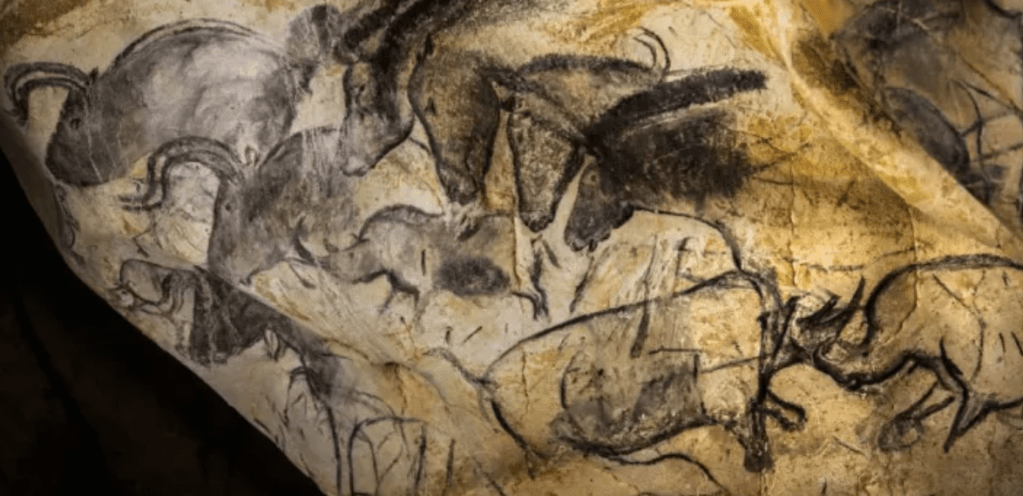
It suddenly felt colder as we were in the cave, which showed their dedication to make it submersive to all the visitors. The surroundings were dark with little beams of light and there was no sound in the cave except the tapping of the people’s feet and the loud vibrant sound of the tour guide. Somehow they made what the tour guide was saying synchronised with the audio guide. The tour guide talked about the different bits of history in every corner of the cave, for instance, the skulls of bears that used to hibernate in this cave. It was fascinating to see the distorted structure of the cave, some narrow dark tunnels leading to unknown places. Most of the time I was listening to the audio guide, but sometimes interest took over me and I faded away from the guide, inspecting different traits of the cave. After a short while of repeating these intervals of inspection, we came to the two famous paintings from our ancestors: one was the clump of red dots which, to me, looked like a deer, then came the best part. There was a horde of Horses, Bull, Pigs and Rhinoceros paintings (painted with thick black paint) packed together. In just that one scene of the horde of animals, I could see all the action happening. They were all sprinting in an orderly way and in the same direction towards the beautiful rock valley, (which they also painted.) It all happened so quickly, as if it were a small dosage of fascinating history. I wish I had another chance to go back there and have the experience all over again.
 Rich&Will's Exp Travel
Leave a comment